Every now and then, you’ll find an indie publisher posting their sales data (money and all) direct on their website for all to see. The biggest one of them all would be Evil Hat Productions, currently the mecca for all indie publishers looking to make it big. Those with business degrees would wonder why someone who do such a thing and give away any potential secrets to their success or reveal how poorly they’re doing in the market, but that’s the thing about indie publishing: we all ride on everyone’s success. Besides, the motto around here is “breaking all the rules,” so it’s not like we’re about to do what’s proper.
As the Big Cheese around here, I’ve been meaning to get around to posting these at the start of every quarter (April, July, October, and January) since our merger with Mystical Throne Entertainment. It’s just never panned out that way… until today. So when I say these are the figures Broken Ruler Games produced in the first half of the year, there should be a clarification that these results are actually what’s gone down since the merger back in late November of 2014. In essence, this is how things have fared with BRG since we started bunking with MTE. A fair warning that I will not provide any $ with these totals as anyone can figure those out if someone was really set on it and as BRG is in a partnership, such figures were deemed irrelevant and improper for this post.
Let’s Start From The Top, Shall We?
First off, the total figures from November 23, 2014 to the end of June 2015. Plain and simple, a total of 2642 purchases – downloads, freebies, and POD sales – took place (not including bundles, of which there were 26). Of those, 1933 were made available at no profit to us whatsoever for a charity bundle back in April of this year and 541 came from the recently exhilarating Bundle of Holding last month. Here’s a breakdown of exactly what was purchased, regardless of source.
Killshot: The Director’s Cut
Total Sales – 578
(576 PDF, 2 print on demand)
Killshot: An Assassin’s Journal
Total Sales – 1955 (includes the 1933 for the charity bundle)
(1954 PDF, 1 print on demand)
Killshot: Direction
Total Sales – 0
Killshot Files #0: Redemption
Total Sales – 47 (all PDF)
Killshot Files #1
Total Sales – 31 (all PDF)
KIllshot Files #2
Total Sales – 31 (all PDF)
Before vs. After Partnership
As noted above, BRG formed a development partnership with Mystical Throne late last year, thereby allowing myself to move away from the day-to-day requirements of publishing and carry on with game design and project development. Not a day goes by when I’m not thankful for that and to prove how effective and agreeable a decision that was, I’m going to share one tiny dollar sign with you.
$40
That’s the exact difference in net earnings BRG has collected since the partnership formed compared everything else before hand. Yep, in only seven months and a few days, the partnership has allowed us to make almost as much as it took in 2.5 years trying by myself. Which is why today’s lesson is always learn how to chew your humble pie and know when to turn to someone with better skills than you.
While I will admit the biggest difference was participating in the Bundle of Holding, no doubt about it, for otherwise that difference would be closer to $600 but even with individual downloads alone there are 667 more copies of Killshot products on people’s computers since the partnership than beforehand. Even if a large portion of that boost came from a charity bundle and not a dime into our coffers, that’s a significant number more gamers with opportunity to discover our work (and we were able to help out a family in dire times, making it well worth the extra dust in the wallet). In short, there are now 4,609 editions of Killshot around the world as of the end of 2015’s first half. All in all, this year’s turning out Broken. (Wait, does that sound right?)
Up And Coming? Why, ScreenPlay’s Playtest Edition, Of Course
The time has come to start filling the virtual shelves with more than just Killshot products. It’s time to start moving forward with our next game, ScreenPlay. At this time, I’m cracking away at a special Playtest Edition of the storytelling RPG system with plans to launch this sneak peak by Autumn of this year. And by Playtest Edition, I mean a glimpse at what the game is about with enough detail to break it out at your table (complete with advice for Directors and Writers crafting their own tales and an introductory, grim fantasy treatment called Ironbound) and incentives for readers and players alike to help fortify this game into something stronger than I could ever imagine. Think of Kickstarter-style rewards without having to shell out money and instead sharing your feedback. Details to come as they become available, so stay frosty on that by keeping an eye on our ScreenPlay page.
For now, that’s everything… oh, wait. There is one more thing I’d like to announce, something a little more personal and fitting to this section. There’s a new body here in the Broken Office and while his skills won’t be put to the test for many years to come, there’s a new member of the team here nonetheless.
My son, Logan. And yes, his dice are already on order.
Sincerely,
The Warden
Proud Publisher and Papa
Broken Ruler Games
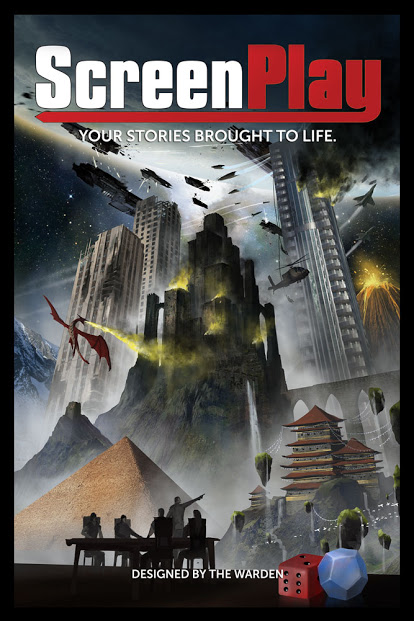
A cover can make or break a project, or it can bring it to the attention of those who would otherwise keep their head turned in the other direction. So when I contacted digital artist, Jeff Brown, in regards to creating a cover for our next project, ScreenPlay, there was a serious question to consider: what one image can turn heads for this upcoming story RPG? It didn’t take long to learn the answer: we needed to show many possibilities.
Roleplaying game covers tend to share common visual similarities and that’s especially true with universal systems like ScreenPlay. When your game can provide for a variety of genres, settings, time periods, and more, you tend to see things like individual images in thought bubbles or separated ideas brought together around a group of highly charged player characters… these were all things I wanted to avoid, yet also wanted to invoke. Don’t fix what ain’t broke, right? Jeff’s specialty is environmental/landscape art and the reason why I chose him was because this cover needed to showcase where these future stories could take place, not theorize who was going to feature in them. What we devised, I think, mashes all those ideas and possibilities together into a cover that I’m damn proud to slap a BRG logo on. A endless universe of danger, intrigue, and excitement existing in one place at one time as a group of Writers and their Director decide which story to tell. It’s a cover that’s already started turning heads, based on the result I’ve seen on my personal G+ account too. If it does the same for you, click here or on the cover image to the right and proceed to see what this upcoming mindblower is all about.
I’m happy to say the alpha-phase playtesting for both ScreenPlay and High Plains Samurai is well underway and so far banging out all the kinks in the mechanics and smoothing out the presentation. At this phase, we’re really testing out ScreenPlay and using HPS as an excuse to dive into this setting my Development Team and I created two years ago – it doesn’t take much arm twisting to get us diving into the dusty plains of the One Land. But that’s not what I’m writing about today.
With playtesting underway, it’s time to start shooting some holes in the walls keeping this game shrouded in darkness and expose it to some sunlight. In other words, it’s time for you to start learning more about what makes ScreenPlay… well, ScreenPlay. I put it that way because this game is unlike other roleplaying games. It’s built on a foundation of everything that is an RPG, but there is one major facet turned on its head for a dynamic and refreshing change of pace. Maybe I’m a bit biased (that happens when you design a game – it’s always the greatest achievement in game design as far as you’re concerned), but let’s allow the features of the game to speak for itself.
Here are the 4 key features of ScreenPlay and why you should be chomping at the bit to play. It’s also why you should be eager to discover more about High Plains Samurai too, seeing as the ScreenPlay engine will be powering this post-apocalyptic/western/wushu/super-powered mash-up. Whenever you see anything written in blue italics, that means it’s an important term in the game.
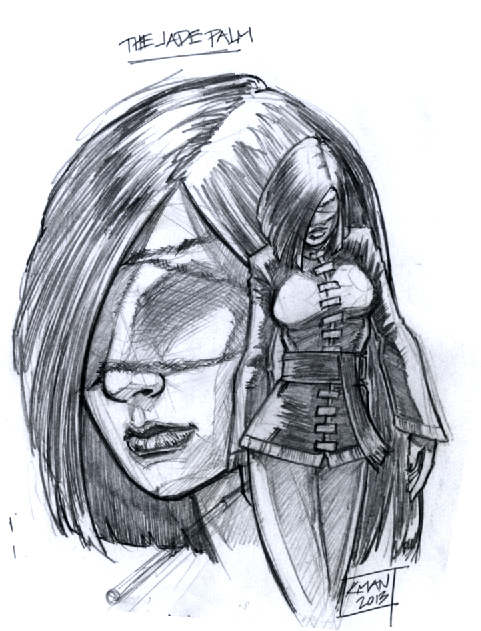
Gaze upon the deadly beauty known only as the Jade Palm, one of the High Plains Samurai playtest characters for the project’s lead artist, Kieron O’Gorman. Don’t let her blindness fool her for she can see far more than anyone in the One Land.
#1) It’s A Story Game Where The Players Are The Storytellers
If you’re familiar with the concept of story games, you already know what I’m talking about. If not, there’s a fine line between these and your traditional roleplaying games. While differences of opinion exist on the exact definition, a story game allows greater control to the players using loose fitting mechanics and provides a more co-operative creative experience. If your traditional RPG has the Gamemaster dictating all the events in the story with players simply reacting through their characters, story games break from this aspect and allow the players to invest their own ideas into the story. Perhaps one of the best known story games on the market is Fate and I encourage you to check it out if you’ve never heard of it before.
ScreenPlay takes this a step further and places equal creative duties on both the players and the Director (AKA the Gamemaster, or GM). Each player is assigned the role of a Writer and creates a variety of characters (starting with at least one lead character with room to create as many supporting characters as they can handle) to tell a story. On their turns, each Writer provides a description for one character, an active account of how that particular individual propels the story forward. This is followed by an outcome from the Director, reacting to the description and rewarding the Writer with surrounding details, events, and reactions from other characters involved in the scene. The key difference between this and other games is that there are no point exchanges required for a Writer to insert their own ideas into the story – if she decides this story needs a fight scene, she can simply describe her character witnessing four shadow-cloaked ninjas leaping down from the rooftops with swords drawn. It’s now up to the Director to make this fight go down.
This is just one of the sketches HPS’ artist, Kieron O’Gorman creates on the fly during each session. It’s incredibly handy to have your artist also work on your Development Team and act as a playtester.
#2) The Director Keeps The Plot Moving Without Taking Control
There’s more to being a Director in ScreenPlay than simply reacting to anything the Writers want, oh no. Each story – whether it’s conceived by everyone in the group or using a pre-purchased treatment (AKA adventure) – has a basic plot for the Director to use as a guideline. As an example, High Plains Samurai is a large scale treatment providing a setting (the One Land), history, a cast of supporting characters and extras, and a series of markers (key story moments) all designed to provide a working platform for the Writers to remain on track. While the Writers are telling the story, the Director uses his tools to integrate the treatment, facilitate the story and package it all together to reveal what wonderful outcomes the Writers are creating. During our playtests, I’ve been inclined to use camera angles and moviemaking terminology as a means of detailing our particular version of High Plains Samurai as if you were watching it on the big screen or as part of an awesome ongoing HBO drama.
One of the Director’s key tools for keeping it all together are triggers, pre-determined or instant reactions to descriptions. For example, the lead characters ride up towards the main gates of the City of Rust in the hopes of entering this rancid metropolis. What the Writers do not know and the Director does is that snipers line the walls looking for this posse with orders to shoot. As a Writer describes her character riding along the main road, the Director applies the trigger and cuts into the description by rolling dice as the crack of a rifle cuts through the dusty plains. A trigger can be avoided, even without the Writers knowing there was a trigger, if their characters learned about these snipers in advance and snuck into the city under cover of night. A Director can also devise triggers on the fly as a means of helping to keep the story moving along, like having the barkeep intervene when the lead characters become preoccupied with them surly buggers giving them the dirty eye from the back of the bar.
Think of it as improvised storytelling and the Director is there to make sure no one falls off stage. Just like directors of stage and cinema, the Director helps keep the story exciting and engaging through the outcomes they provide and the triggers they set to keep the Writers on their toes. What results is a fresh and exciting storytelling experience where the Director gets to experience the same thrill of discovery as your typical RPG player does every game.
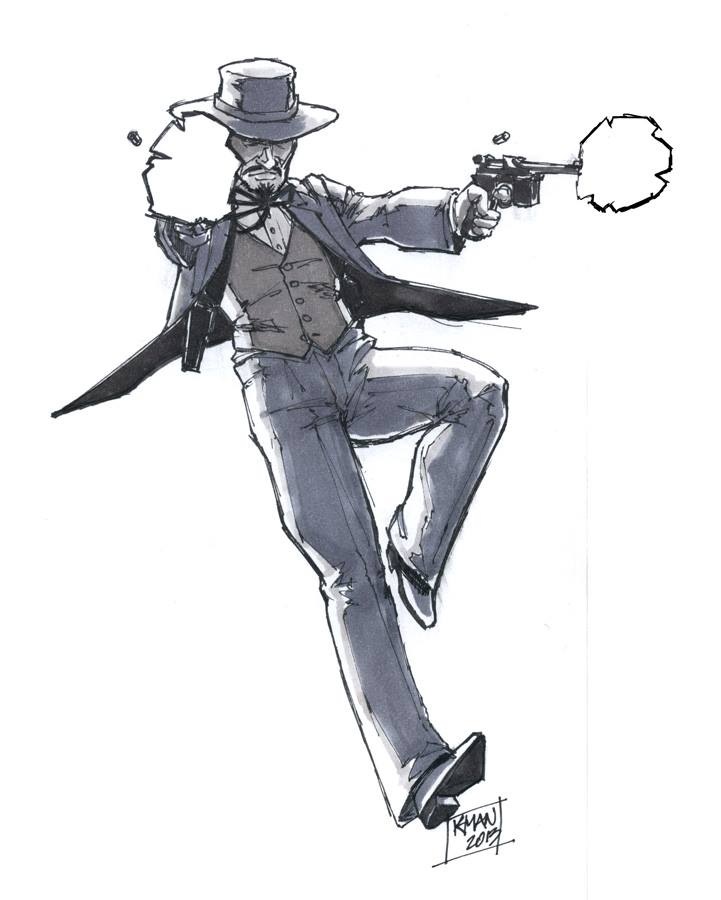
One of the first early sketches completed by Kieron. Notice how this gentleman gunslinger is firing two automatic handguns? That’s because there’s more to High Plains Samurai than a simple western/wushu/post-apocalyptic/superhuman story…
#3) Conflict Is As Easy As Knowing Odds vs. Evens
Are there dice rolls in ScreenPlay? You betcha – I wouldn’t design a game without them. I’m a sucker for dice rolls and the goal with creating ScreenPlay was to allow a simple, fast-paced resolution system where the dice did not blow up in your face. Here’s how it works: certain moments in the story, as told by the Writers, will trigger a conflict roll. That means whoever wants to achieve an action with a risk of consequences must roll against a Difficulty and that target number can be based on the opponent or the task at hand. Each character has a list of Potentials ranging from a d4 to a d12 (along with other modifiers and provisions to increase their odds, but we’ll save that for another day). Choosing an appropriate Potential, the dice are rolled and if the result is equal to or higher than the Difficulty, it’s a success.
But there’s more! You can use that roll to determine how much damage you cause or what effects occur as as result of your conflict roll. These effects are known as complications and range from minor (your gun is out of ammo, being knocked prone) to major (intimidated, acidic sand kicked in your face). Knowing the type of complication is simply a matter of whether or not you rolled an even number (major complications) or an odd number (minor complication). Failure works on the same principle: if you fail with an even number, nothing bad happens to the character, but an odd number results in the character suffering a minor complication of their own. Basically, even numbers are good, odd numbers not so much. Damage works on the same principle with a successful conflict roll: an even number yields major damage (the difference between your roll and the Difficulty plus any damage modifiers) or minor damage (only the damage modifier).
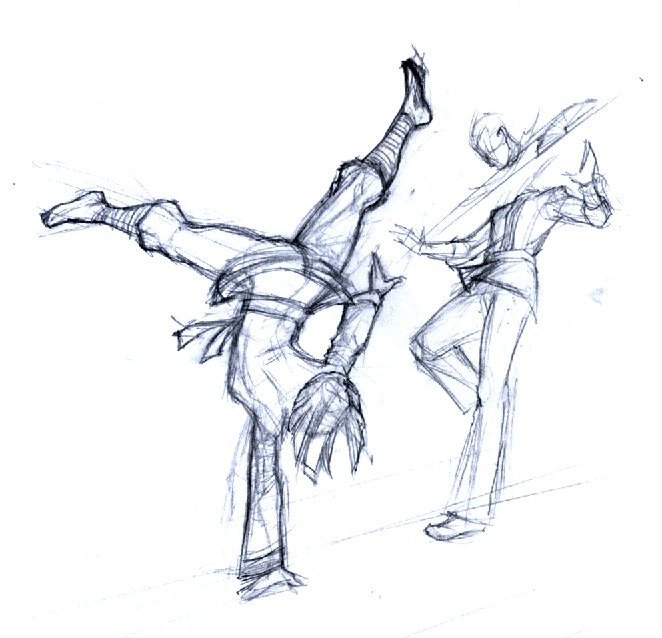
A rough sketch of a sweet moment in our rendition of HPS where Jade Palm decapitates an opponent with a paper fan. What I love about this piece is how fluid and easy she makes it look. You can check out more of Kieron’s work at mayhem graphics.com
#4) Stamina Is The Ultimate Dealbreaker
All characters in ScreenPlay are assigned an amount of Stamina based on their character type (leads, supporting, extras). When a character runs out of Stamina, they’re removed from the story for the scene or permanently. More than just hit points, they also allow characters to break the rules and do things otherwise impossible to your average individual.
For example, most of our lead characters in the High Plains Samurai playtest have unlocked qi (pronounced chi) powers, such as the Jade Palm’s supernatural sense or Ronin’s incredible speed. Each qi power is clearly defined and faces normal limitations, but those can be broken by spending 1 Stamina. Characters can also spend Stamina to interrupt an outcome, retaliate against an opponent, increase/decrease the die roll by 1 (even if it’s not theirs), and so forth. While these applications create a variety of possible outcomes, you must judge your Stamina wisely because too many uses followed by a katana chop to the kidneys will result in 0 Stamina.
Just The Beginning…
Of course, all I’m doing right now is teasing you and that’s the entire point of this. As the Development Team and myself continues to work on banging out the kinks, we get closer and closer to revealing more about how this exciting game can come to life at your next session. And while I’ve been a big tease about it, I’d like to take things a little further. Think of it as spending 1 Stamina to break the rules.
Download the latest ScreenPlay/High Plains Samurai Playtest Draft right here. This particular draft is Version 3 and stems from feedback brought on at our recent session and will give you a greater idea into the fun-sanity that is both ScreenPlay and High Plains Samurai. Until then, you can stay up-to-date with ongoing playtests, working drafts, even ask me questions on the game’s development through our Facebook page, on Twitter, or on Google+.
Until the next time, thanks for reading and I look forward to revealing more about ScreenPlay in the near future.
It is my absolute pleasure to welcome you to the Broken Ruler Games website. Or if you’ve been a fan of BRG before today, welcome to the new and improved site with a swanky new domain name and content.
Before I go into a quick presentation of where you can find everything you need to know on Killshot (especially where to buy your copy) and get a handle on what’s coming up next from the Ruler (ahem! ScreenPlay!), there’s one individual in particular who must be thanked for making this happen. That’s not to say there isn’t an army of people to thank for making the Ruler what it is at this very moment, including the likes of my Development Teams past and present, our fans, customers, and every tabletop gamer out there who has played our work. Without all of you, the doors would have been closed a long time ago, but this one individual in particular literally helped bring this studio back from the dead. And that individual is Aaron Huss, President of Mystical Throne Entertainment.
A couple of months back, I announcement the end of the Ruler across all our social media. Within hours, Aaron sent off an email with an offer: make Broken Ruler Games a development studio under the Mystical Throne banner and I could continue to do the work I loved while he would take care of all the logistical aspects of publishing and marketing. I’ve been working with Aaron for close to three years now (including the second edition of MTE’s Mercenary Breed and the long-running Under The Hood column on Roleplayers Chronicle) and his hard work has helped make MTE a very successful indie RPG publisher, so my answer was a very quick and eager, “Yes!” This new arrangement has given me new vigour and motivation to proceed with everything I had intended for the Ruler without getting bogged down with the necessary burdens of publishing and production management. So if you see anything you like from this day forward, it’s all thanks to Aaron Huss.
But enough with these pleasantries, it’s time to let you check out the new site. You can start by learning more about Broken Ruler Games (which we call “the Ruler” for simplicity’s sake and that essential coolness factor) on the About page. Then jump over to our assembly of Killshot pages to learn all about the ENnie Award winning assassin RPG before seeing what’s in store next with High Plains Samurai (an upcoming B&W/wushu hybrid RPG) and ScreenPlay (the system behind the Samurai and an upcoming improvised standalone roleplaying game). Finally, you can learn about our next phase of the Optional System and the hushed and deadly work of rogue operatives… oh, but I may have said too much already. That one will have to wait for another time.
From there, you can also find us across the social media spectrum and stay up-to-date on our various machinations. Follow us on Facebook, join in on Google+, and read all about it on Twitter. Of course, there’s always good ol’ fashioned email where you can reach me personally at optionalwarden@gmail.com.
Now let’s start making a future together, shall we?
Signed,
The Warden
President/Lead Designer, Broken Ruler Games

 The time has come to start filling the virtual shelves with more than just Killshot products. It’s time to start moving forward with our next game, ScreenPlay. At this time, I’m cracking away at a special Playtest Edition of the storytelling RPG system with plans to launch this sneak peak by Autumn of this year. And by Playtest Edition, I mean a glimpse at what the game is about with enough detail to break it out at your table (complete with advice for Directors and Writers crafting their own tales and an introductory, grim fantasy treatment called Ironbound) and incentives for readers and players alike to help fortify this game into something stronger than I could ever imagine. Think of Kickstarter-style rewards without having to shell out money and instead sharing your feedback. Details to come as they become available, so stay frosty on that by keeping an eye on our ScreenPlay page.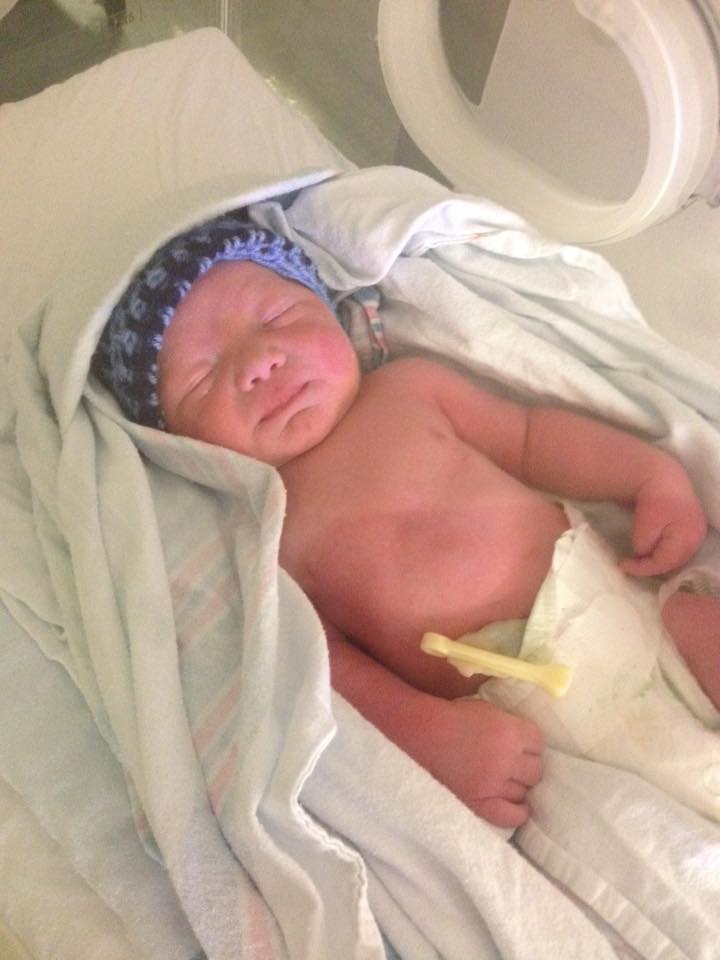


 Broken Ruler Games