What a brilliant, crazy week it has been! Our first week of playtesting for ScreenPlay has now moved into the second week and the results have been helpful, insightful, encouraging, and so much more. There’s a risk in throwing out something unfinished to the void and hoping that most of it will stick to the wall. So far, it seems those of you who have decided to help us out have really latched onto it.
Here’s a brief bullet point update on what’s transpired over the past week.
Version 1.1 of the Rehearsal Edition is averaging 4.4 out of 5 on our surveys
A lot of terrific comments have been shared on the same surveys, as well as some constructive feedback. On Tuesday, October 26th, Version 1.2 of the Rehearsal Edition was updated to everyone who has downloaded the original PDF on DriveThruRPG and RPGNow. The primary focus was a revised approach to Act Two: How To Play using a more traditional approach to mechanics presentation and character creation, along with some modifications to milestones and the additional of character hooks.
The current number of playtest points awarded sits at 11 as of the time of this writing, meaning we’re only 4 more points away from unlocking Nightfall, a modern day superhero story of multiple people acting as a single superhero/vigilante.
Page views to this site for October have tripled the previous highest month and the month isn’t even finished yet.
On the ScreenPlayers Guild G+ Community, we’re getting ready to start a play-by-post rendition of Ironbound, the dark fantasy treatment provided in Version 1.1 of the playtest. If you have yet to join the community, feel free to join in. It’s a great opportunity to see the game in progress and laying down the foundations for how Directors and Writers can set up their own take on a story.
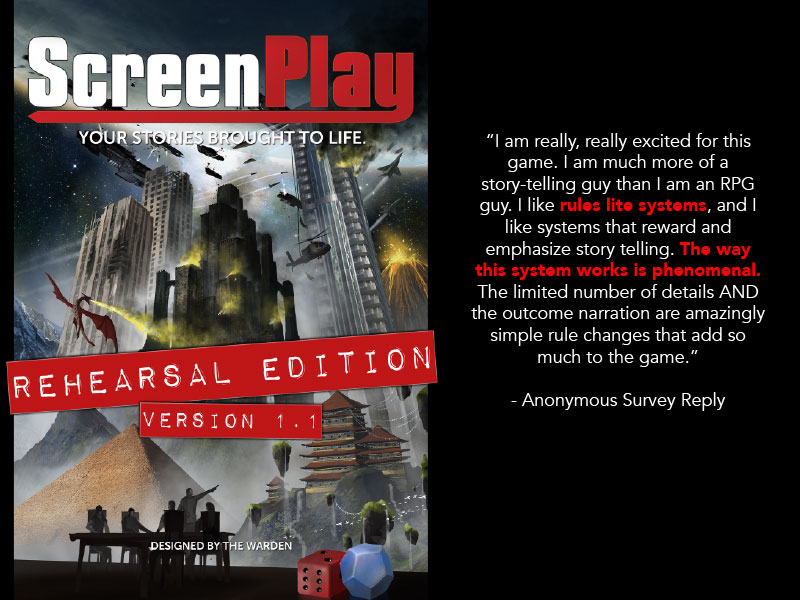
Fifteen weeks remain and the wheels are turning faster than ever. Huge thanks goes out to everyone who has joined in the effort with more than just enthusiasm and has shown this tale is far from over. And remember to keep using the #ScreenPlayRPG hashtag to help get the word out and fill out those surveys to collect those playtest points. Now let’s close out this post with a trio of gracious comments from surveys completed this past week.
The cover for ScreenPlay: The Rehearsal Edition, by Jeff Brown.
Let the games begin!
After two years of development and three months of writing, re-writing, and sweating, ScreenPlay: The Rehearsal Edition [will be] available for free on DriveThruRPG and RPGNow. Aside from putting the first draft of this unique, public playtest edition of our upcoming storytelling RPG, you can also learn everything about the game in our new and expanded ScreenPlay pages.
Get the basics on how the game works on the Learn To ScreenPlay page and see how the pieces fall into place before downloading your free copy;
Unlock the secret of this game’s unique rewards and how this playtest works like a Kickstarter campaign on our Playtest Points page;
Finally, explore the dark secrets of Ironbound, the first treatment for ScreenPlay where the Writers take on the role of these elite witch hunters tasked with protecting the kingdom of Alduire from all forms of magick and rituals.
The time is here, so starting click, start reading and start writing your next story with ScreenPlay.
I’m happy to say the alpha-phase playtesting for both ScreenPlay and High Plains Samurai is well underway and so far banging out all the kinks in the mechanics and smoothing out the presentation. At this phase, we’re really testing out ScreenPlay and using HPS as an excuse to dive into this setting my Development Team and I created two years ago – it doesn’t take much arm twisting to get us diving into the dusty plains of the One Land. But that’s not what I’m writing about today.
With playtesting underway, it’s time to start shooting some holes in the walls keeping this game shrouded in darkness and expose it to some sunlight. In other words, it’s time for you to start learning more about what makes ScreenPlay… well, ScreenPlay. I put it that way because this game is unlike other roleplaying games. It’s built on a foundation of everything that is an RPG, but there is one major facet turned on its head for a dynamic and refreshing change of pace. Maybe I’m a bit biased (that happens when you design a game – it’s always the greatest achievement in game design as far as you’re concerned), but let’s allow the features of the game to speak for itself.
Here are the 4 key features of ScreenPlay and why you should be chomping at the bit to play. It’s also why you should be eager to discover more about High Plains Samurai too, seeing as the ScreenPlay engine will be powering this post-apocalyptic/western/wushu/super-powered mash-up. Whenever you see anything written in blue italics, that means it’s an important term in the game.
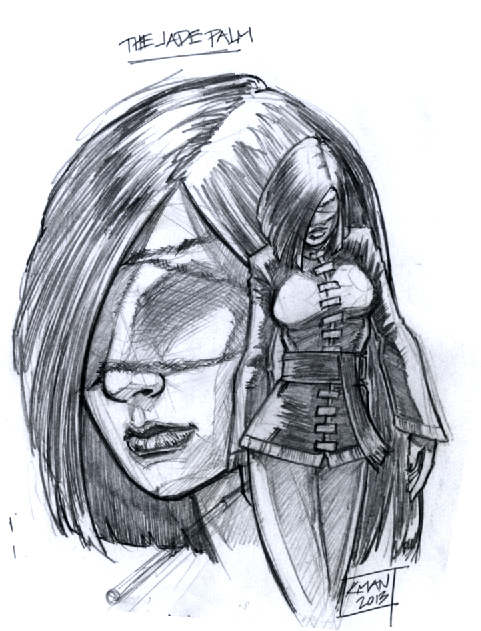
Gaze upon the deadly beauty known only as the Jade Palm, one of the High Plains Samurai playtest characters for the project’s lead artist, Kieron O’Gorman. Don’t let her blindness fool her for she can see far more than anyone in the One Land.
#1) It’s A Story Game Where The Players Are The Storytellers
If you’re familiar with the concept of story games, you already know what I’m talking about. If not, there’s a fine line between these and your traditional roleplaying games. While differences of opinion exist on the exact definition, a story game allows greater control to the players using loose fitting mechanics and provides a more co-operative creative experience. If your traditional RPG has the Gamemaster dictating all the events in the story with players simply reacting through their characters, story games break from this aspect and allow the players to invest their own ideas into the story. Perhaps one of the best known story games on the market is Fate and I encourage you to check it out if you’ve never heard of it before.
ScreenPlay takes this a step further and places equal creative duties on both the players and the Director (AKA the Gamemaster, or GM). Each player is assigned the role of a Writer and creates a variety of characters (starting with at least one lead character with room to create as many supporting characters as they can handle) to tell a story. On their turns, each Writer provides a description for one character, an active account of how that particular individual propels the story forward. This is followed by an outcome from the Director, reacting to the description and rewarding the Writer with surrounding details, events, and reactions from other characters involved in the scene. The key difference between this and other games is that there are no point exchanges required for a Writer to insert their own ideas into the story – if she decides this story needs a fight scene, she can simply describe her character witnessing four shadow-cloaked ninjas leaping down from the rooftops with swords drawn. It’s now up to the Director to make this fight go down.
This is just one of the sketches HPS’ artist, Kieron O’Gorman creates on the fly during each session. It’s incredibly handy to have your artist also work on your Development Team and act as a playtester.
#2) The Director Keeps The Plot Moving Without Taking Control
There’s more to being a Director in ScreenPlay than simply reacting to anything the Writers want, oh no. Each story – whether it’s conceived by everyone in the group or using a pre-purchased treatment (AKA adventure) – has a basic plot for the Director to use as a guideline. As an example, High Plains Samurai is a large scale treatment providing a setting (the One Land), history, a cast of supporting characters and extras, and a series of markers (key story moments) all designed to provide a working platform for the Writers to remain on track. While the Writers are telling the story, the Director uses his tools to integrate the treatment, facilitate the story and package it all together to reveal what wonderful outcomes the Writers are creating. During our playtests, I’ve been inclined to use camera angles and moviemaking terminology as a means of detailing our particular version of High Plains Samurai as if you were watching it on the big screen or as part of an awesome ongoing HBO drama.
One of the Director’s key tools for keeping it all together are triggers, pre-determined or instant reactions to descriptions. For example, the lead characters ride up towards the main gates of the City of Rust in the hopes of entering this rancid metropolis. What the Writers do not know and the Director does is that snipers line the walls looking for this posse with orders to shoot. As a Writer describes her character riding along the main road, the Director applies the trigger and cuts into the description by rolling dice as the crack of a rifle cuts through the dusty plains. A trigger can be avoided, even without the Writers knowing there was a trigger, if their characters learned about these snipers in advance and snuck into the city under cover of night. A Director can also devise triggers on the fly as a means of helping to keep the story moving along, like having the barkeep intervene when the lead characters become preoccupied with them surly buggers giving them the dirty eye from the back of the bar.
Think of it as improvised storytelling and the Director is there to make sure no one falls off stage. Just like directors of stage and cinema, the Director helps keep the story exciting and engaging through the outcomes they provide and the triggers they set to keep the Writers on their toes. What results is a fresh and exciting storytelling experience where the Director gets to experience the same thrill of discovery as your typical RPG player does every game.
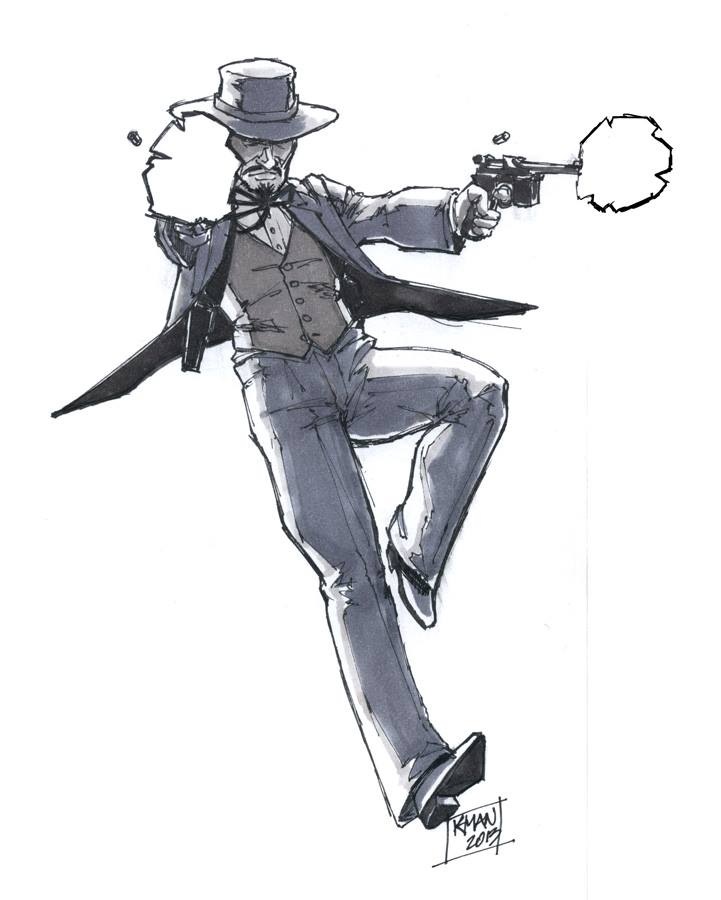
One of the first early sketches completed by Kieron. Notice how this gentleman gunslinger is firing two automatic handguns? That’s because there’s more to High Plains Samurai than a simple western/wushu/post-apocalyptic/superhuman story…
#3) Conflict Is As Easy As Knowing Odds vs. Evens
Are there dice rolls in ScreenPlay? You betcha – I wouldn’t design a game without them. I’m a sucker for dice rolls and the goal with creating ScreenPlay was to allow a simple, fast-paced resolution system where the dice did not blow up in your face. Here’s how it works: certain moments in the story, as told by the Writers, will trigger a conflict roll. That means whoever wants to achieve an action with a risk of consequences must roll against a Difficulty and that target number can be based on the opponent or the task at hand. Each character has a list of Potentials ranging from a d4 to a d12 (along with other modifiers and provisions to increase their odds, but we’ll save that for another day). Choosing an appropriate Potential, the dice are rolled and if the result is equal to or higher than the Difficulty, it’s a success.
But there’s more! You can use that roll to determine how much damage you cause or what effects occur as as result of your conflict roll. These effects are known as complications and range from minor (your gun is out of ammo, being knocked prone) to major (intimidated, acidic sand kicked in your face). Knowing the type of complication is simply a matter of whether or not you rolled an even number (major complications) or an odd number (minor complication). Failure works on the same principle: if you fail with an even number, nothing bad happens to the character, but an odd number results in the character suffering a minor complication of their own. Basically, even numbers are good, odd numbers not so much. Damage works on the same principle with a successful conflict roll: an even number yields major damage (the difference between your roll and the Difficulty plus any damage modifiers) or minor damage (only the damage modifier).
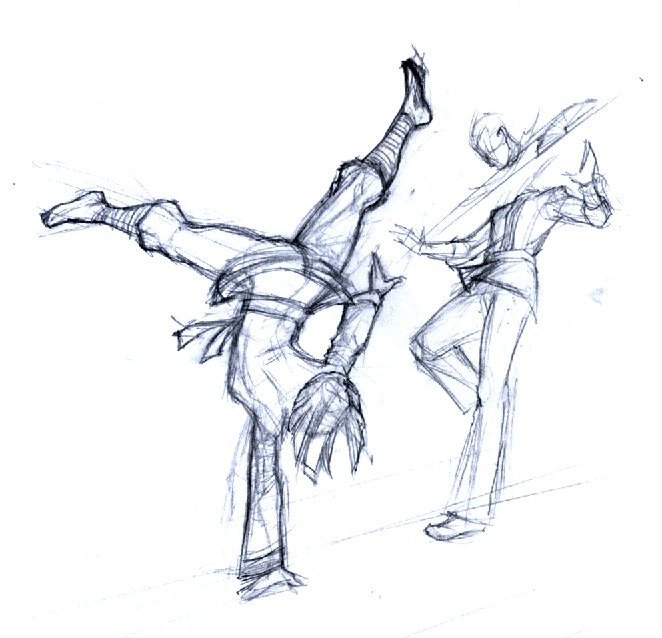
A rough sketch of a sweet moment in our rendition of HPS where Jade Palm decapitates an opponent with a paper fan. What I love about this piece is how fluid and easy she makes it look. You can check out more of Kieron’s work at mayhem graphics.com
#4) Stamina Is The Ultimate Dealbreaker
All characters in ScreenPlay are assigned an amount of Stamina based on their character type (leads, supporting, extras). When a character runs out of Stamina, they’re removed from the story for the scene or permanently. More than just hit points, they also allow characters to break the rules and do things otherwise impossible to your average individual.
For example, most of our lead characters in the High Plains Samurai playtest have unlocked qi (pronounced chi) powers, such as the Jade Palm’s supernatural sense or Ronin’s incredible speed. Each qi power is clearly defined and faces normal limitations, but those can be broken by spending 1 Stamina. Characters can also spend Stamina to interrupt an outcome, retaliate against an opponent, increase/decrease the die roll by 1 (even if it’s not theirs), and so forth. While these applications create a variety of possible outcomes, you must judge your Stamina wisely because too many uses followed by a katana chop to the kidneys will result in 0 Stamina.
Just The Beginning…
Of course, all I’m doing right now is teasing you and that’s the entire point of this. As the Development Team and myself continues to work on banging out the kinks, we get closer and closer to revealing more about how this exciting game can come to life at your next session. And while I’ve been a big tease about it, I’d like to take things a little further. Think of it as spending 1 Stamina to break the rules.
Download the latest ScreenPlay/High Plains Samurai Playtest Draft right here. This particular draft is Version 3 and stems from feedback brought on at our recent session and will give you a greater idea into the fun-sanity that is both ScreenPlay and High Plains Samurai. Until then, you can stay up-to-date with ongoing playtests, working drafts, even ask me questions on the game’s development through our Facebook page, on Twitter, or on Google+.
Until the next time, thanks for reading and I look forward to revealing more about ScreenPlay in the near future.

 What a brilliant, crazy week it has been! Our first week of playtesting for ScreenPlay has now moved into the second week and the results have been helpful, insightful, encouraging, and so much more. There’s a risk in throwing out something unfinished to the void and hoping that most of it will stick to the wall. So far, it seems those of you who have decided to help us out have really latched onto it.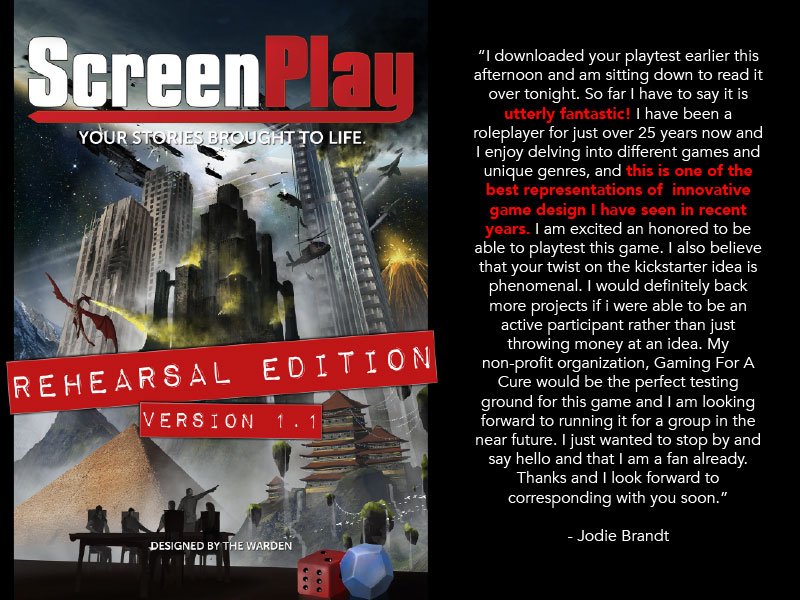



 Broken Ruler Games