
What Is ScreenPlay?

ScreenPlay_logo_earlyHighPlainsSamurai_logo_v1I’m happy to say the alpha-phase playtesting for both ScreenPlay and High Plains Samurai is well underway and so far banging out all the kinks in the mechanics and smoothing out the presentation. At this phase, we’re really testing out ScreenPlay and using HPS as an excuse to dive into this setting my Development Team and I created two years ago – it doesn’t take much arm twisting to get us diving into the dusty plains of the One Land. But that’s not what I’m writing about today.

With playtesting underway, it’s time to start shooting some holes in the walls keeping this game shrouded in darkness and expose it to some sunlight. In other words, it’s time for you to start learning more about what makes ScreenPlay… well, ScreenPlay. I put it that way because this game is unlike other roleplaying games. It’s built on a foundation of everything that is an RPG, but there is one major facet turned on its head for a dynamic and refreshing change of pace. Maybe I’m a bit biased (that happens when you design a game – it’s always the greatest achievement in game design as far as you’re concerned), but let’s allow the features of the game to speak for itself.

Here are the 4 key features of ScreenPlay and why you should be chomping at the bit to play. It’s also why you should be eager to discover more about High Plains Samurai too, seeing as the ScreenPlay engine will be powering this post-apocalyptic/western/wushu/super-powered mash-up. Whenever you see anything written in blue italics, that means it’s an important term in the game.
thejadepalm
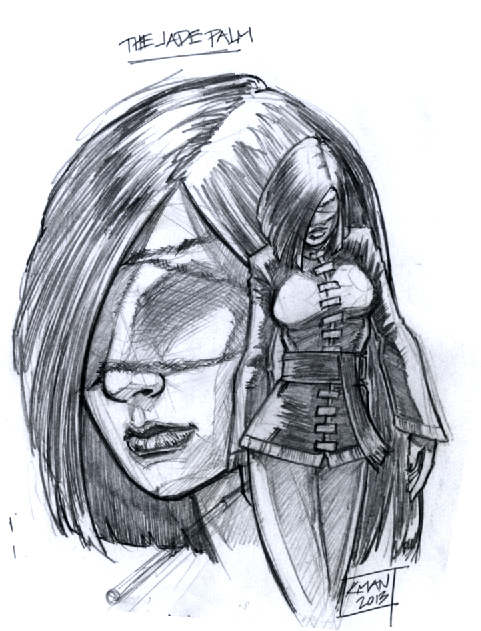
Gaze upon the deadly beauty known only as the Jade Palm, one of the High Plains Samurai playtest characters for the project’s lead artist, Kieron O’Gorman. Don’t let her blindness fool her for she can see far more than anyone in the One Land.

#1) It’s A Story Game Where The Players Are The Storytellers

If you’re familiar with the concept of story games, you already know what I’m talking about. If not, there’s a fine line between these and your traditional roleplaying games. While differences of opinion exist on the exact definition, a story game allows greater control to the players using loose fitting mechanics and provides a more co-operative creative experience. If your traditional RPG has the Gamemaster dictating all the events in the story with players simply reacting through their characters, story games break from this aspect and allow the players to invest their own ideas into the story. Perhaps one of the best known story games on the market is Fate and I encourage you to check it out if you’ve never heard of it before.

ScreenPlay takes this a step further and places equal creative duties on both the players and the Director (AKA the Gamemaster, or GM). Each player is assigned the role of a Writer and creates a variety of characters (starting with at least one lead character with room to create as many supporting characters as they can handle) to tell a story. On their turns, each Writer provides a description for one character, an active account of how that particular individual propels the story forward. This is followed by an outcome from the Director, reacting to the description and rewarding the Writer with surrounding details, events, and reactions from other characters involved in the scene. The key difference between this and other games is that there are no point exchanges required for a Writer to insert their own ideas into the story – if she decides this story needs a fight scene, she can simply describe her character witnessing four shadow-cloaked ninjas leaping down from the rooftops with swords drawn. It’s now up to the Director to make this fight go down.
sign
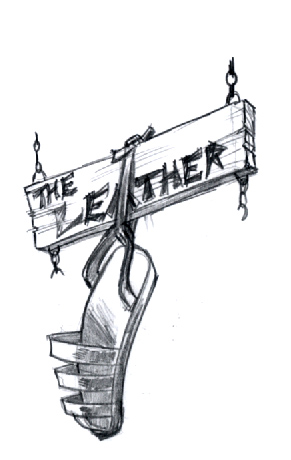
This is just one of the sketches HPS’ artist, Kieron O’Gorman creates on the fly during each session. It’s incredibly handy to have your artist also work on your Development Team and act as a playtester.

#2) The Director Keeps The Plot Moving Without Taking Control

There’s more to being a Director in ScreenPlay than simply reacting to anything the Writers want, oh no. Each story – whether it’s conceived by everyone in the group or using a pre-purchased treatment (AKA adventure) – has a basic plot for the Director to use as a guideline. As an example, High Plains Samurai is a large scale treatment providing a setting (the One Land), history, a cast of supporting characters and extras, and a series of markers (key story moments) all designed to provide a working platform for the Writers to remain on track. While the Writers are telling the story, the Director uses his tools to integrate the treatment, facilitate the story and package it all together to reveal what wonderful outcomes the Writers are creating. During our playtests, I’ve been inclined to use camera angles and moviemaking terminology as a means of detailing our particular version of High Plains Samurai as if you were watching it on the big screen or as part of an awesome ongoing HBO drama.

One of the Director’s key tools for keeping it all together are triggers, pre-determined or instant reactions to descriptions. For example, the lead characters ride up towards the main gates of the City of Rust in the hopes of entering this rancid metropolis. What the Writers do not know and the Director does is that snipers line the walls looking for this posse with orders to shoot. As a Writer describes her character riding along the main road, the Director applies the trigger and cuts into the description by rolling dice as the crack of a rifle cuts through the dusty plains. A trigger can be avoided, even without the Writers knowing there was a trigger, if their characters learned about these snipers in advance and snuck into the city under cover of night. A Director can also devise triggers on the fly as a means of helping to keep the story moving along, like having the barkeep intervene when the lead characters become preoccupied with them surly buggers giving them the dirty eye from the back of the bar.

Think of it as improvised storytelling and the Director is there to make sure no one falls off stage. Just like directors of stage and cinema, the Director helps keep the story exciting and engaging through the outcomes they provide and the triggers they set to keep the Writers on their toes. What results is a fresh and exciting storytelling experience where the Director gets to experience the same thrill of discovery as your typical RPG player does every game.
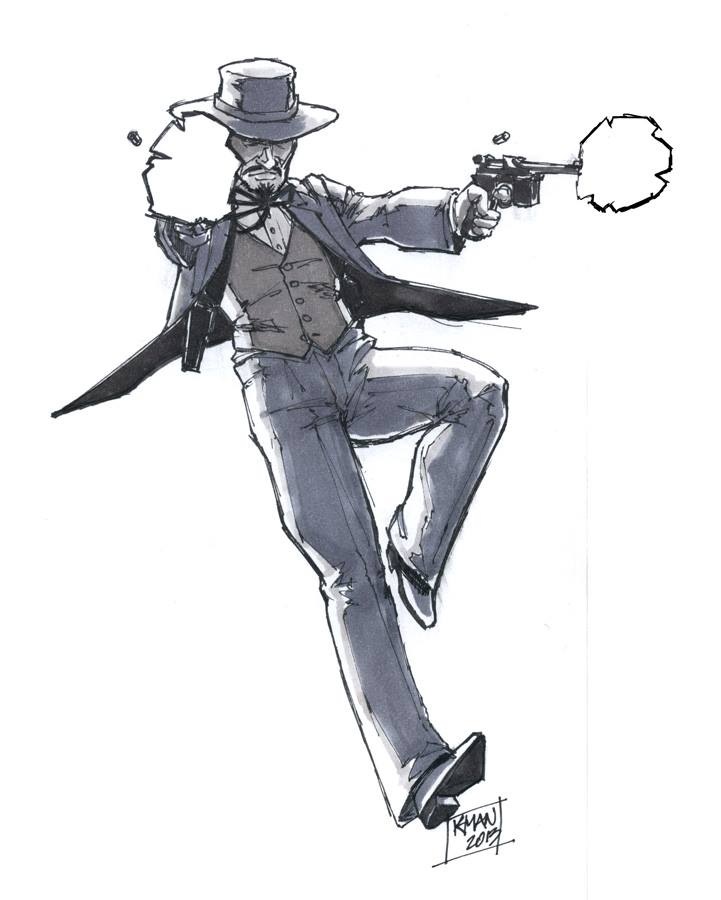
GentlemanGunslinger_v1
One of the first early sketches completed by Kieron. Notice how this gentleman gunslinger is firing two automatic handguns? That’s because there’s more to High Plains Samurai than a simple western/wushu/post-apocalyptic/superhuman story…

#3) Conflict Is As Easy As Knowing Odds vs. Evens

Are there dice rolls in ScreenPlay? You betcha – I wouldn’t design a game without them. I’m a sucker for dice rolls and the goal with creating ScreenPlay was to allow a simple, fast-paced resolution system where the dice did not blow up in your face. Here’s how it works: certain moments in the story, as told by the Writers, will trigger a conflict roll. That means whoever wants to achieve an action with a risk of consequences must roll against a Difficulty and that target number can be based on the opponent or the task at hand. Each character has a list of Potentials ranging from a d4 to a d12 (along with other modifiers and provisions to increase their odds, but we’ll save that for another day). Choosing an appropriate Potential, the dice are rolled and if the result is equal to or higher than the Difficulty, it’s a success.

But there’s more! You can use that roll to determine how much damage you cause or what effects occur as as result of your conflict roll. These effects are known as complications and range from minor (your gun is out of ammo, being knocked prone) to major (intimidated, acidic sand kicked in your face). Knowing the type of complication is simply a matter of whether or not you rolled an even number (major complications) or an odd number (minor complication). Failure works on the same principle: if you fail with an even number, nothing bad happens to the character, but an odd number results in the character suffering a minor complication of their own. Basically, even numbers are good, odd numbers not so much. Damage works on the same principle with a successful conflict roll: an even number yields major damage (the difference between your roll and the Difficulty plus any damage modifiers) or minor damage (only the damage modifier).
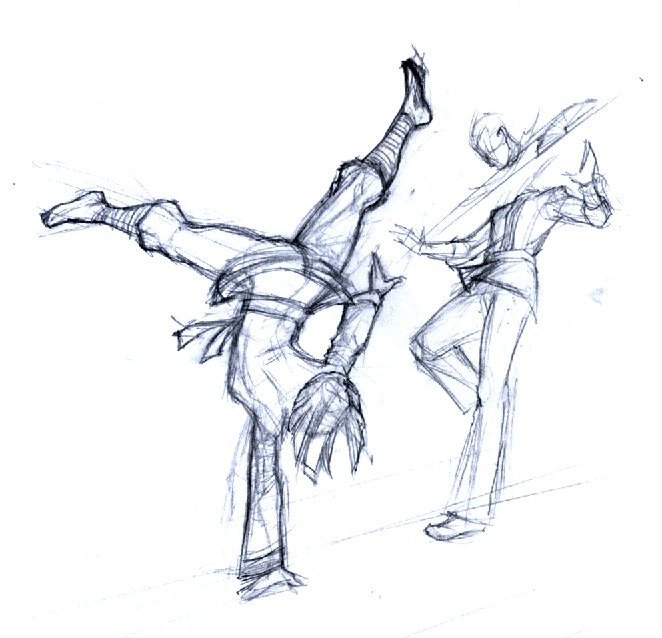
Fanbeheading
A rough sketch of a sweet moment in our rendition of HPS where Jade Palm decapitates an opponent with a paper fan. What I love about this piece is how fluid and easy she makes it look. You can check out more of Kieron’s work at mayhem graphics.com

#4) Stamina Is The Ultimate Dealbreaker

All characters in ScreenPlay are assigned an amount of Stamina based on their character type (leads, supporting, extras). When a character runs out of Stamina, they’re removed from the story for the scene or permanently. More than just hit points, they also allow characters to break the rules and do things otherwise impossible to your average individual.

For example, most of our lead characters in the High Plains Samurai playtest have unlocked qi (pronounced chi) powers, such as the Jade Palm’s supernatural sense or Ronin’s incredible speed. Each qi power is clearly defined and faces normal limitations, but those can be broken by spending 1 Stamina. Characters can also spend Stamina to interrupt an outcome, retaliate against an opponent, increase/decrease the die roll by 1 (even if it’s not theirs), and so forth. While these applications create a variety of possible outcomes, you must judge your Stamina wisely because too many uses followed by a katana chop to the kidneys will result in 0 Stamina.

Just The Beginning…

Of course, all I’m doing right now is teasing you and that’s the entire point of this. As the Development Team and myself continues to work on banging out the kinks, we get closer and closer to revealing more about how this exciting game can come to life at your next session. And while I’ve been a big tease about it, I’d like to take things a little further. Think of it as spending 1 Stamina to break the rules.

Download the latest ScreenPlay/High Plains Samurai Playtest Draft right here. This particular draft is Version 3 and stems from feedback brought on at our recent session and will give you a greater idea into the fun-sanity that is both ScreenPlay and High Plains Samurai. Until then, you can stay up-to-date with ongoing playtests, working drafts, even ask me questions on the game’s development through our Facebook page, on Twitter, or on Google+.

Until the next time, thanks for reading and I look forward to revealing more about ScreenPlay in the near future.

Sincerely,

The Warden

GM Day Sale – Save 30% on Killshot

Show your GM some love.. or blood. Or simply take advantage of the savings to snag a copy of Killshot for yourself. Whatever your reason, our entire catalogue on RPGNow & DriveThruRPG is 30% in honour of GMs Day. Available for a limited time, so act fast before it’s over!

Killshot Goes Hollywood: Killer Elite vs. John Wick

Let’s face it, assassins are nothing new to fiction or roleplaying games. They’ve long been a part of our cultural psyche as mythical figures of darkness lurking in the darkness, sometimes as rogue heroes and other times as blood spilling villains. They’re effective in quite a few genres, including thrillers, spy novels, mysteries, and action. While many RPGs are inspired by novels and other works of text-based fiction, Killshot grew from a love of two genres: action films and true crime.

For this post, we’re going to deal with the former because there are two movies that may just be the perfect representations of where you can go with your Killshot career. Each one offers a different glimpse of the assassin’s world, be it a gritty glimpse of the world around us or a stylish presentation of a shadowy underworld. Killer Elite One Sheet

The first is Killer Elite, starring Jason Statham and Robert DeNiro. This is one I prefer to call “Killshot: The Movie” because there are so many aspects of the game mimicked in this film (save for Evidence Points). Loosely based on a true story (so the studio says), Statham stars as Danny, a retired professional assassin from the 1980s trying to lead a normal life after being in the business for far too long. It’s a standard trope of many underworld films, sure, but that’s not what we’re here to discuss. He’s dragged back into the fold after discovering his old friend and colleague, Hunter (played by DeNiro) has been captured by an Arab Shiek. In exchange for the release of his friend, the Shiek wants Danny to kill three British Special Forces officers involved in the death of his son. As I said, nothing truly unique in the plot here, but what makes this film stand out is the group dynamic of assassination. Danny works with a team to complete each job to eliminate every mark without arousing any suspicion. Both of these are major aspects of Killshot and along with so many other touches, it’s no wonder I personally turn to Killer Elite to explain what the game is truly about. John_Wick_TeaserPoster

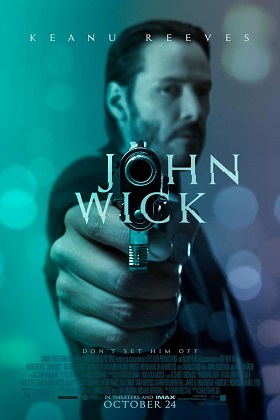
Just like assassination, however, there’s more than one way to skin a mark. That’s where John Wick comes in. The stand alone retired hitman – another played out concept, indeed – this cinematic stunt-laden film puts a different spin on professional assassination through its setting. Keanu Reeves is the titular character out to avenge the death of his puppy (which was a gift from the dying wife, just in case anyone out there doesn’t believe you should go on a killing spree when someone kills your absolutely adorable puppy).

Unlike Killshot, this film is all about the lone assassin kicking ass ten times over, but it’s the setting that truly stands out for any Director looking to go this route with their players career. Two aspects in particular are incredibly perfect for any Killshot career: the Continental and the use of gold coins. The Continental appears to be a legit hotel operating out in the open, but it is run exclusively for underworld figures – particularly assassins – operating in the city. One rule remains in the Hotel – no business is to be conducted inside. That means no grudges, no hits, no gunplay. Abide by this simple rule and you will be treated like an honoured guest; break it and your membership will be revoked (in the form of several bullets to the head). The second is the use of specialized gold coin as a form of underworld currency. Untraceable and applicable only in criminal circles, they’re a handy way of working out transactions without bogging your game down with details and payment arrangements. Plus, if your players come from traditional fantasy RPGs, it’s a great nod to their origins. (And also a personal favourite approach as I’m never a fan of money in any game.)

Both of these films give you just a sampling of how unique your own Killshot career can be, no matter how you choose to approach it. There are many other excellent (and yes, crappy) assassin flicks out there – what do you recommend?

Organization and Time

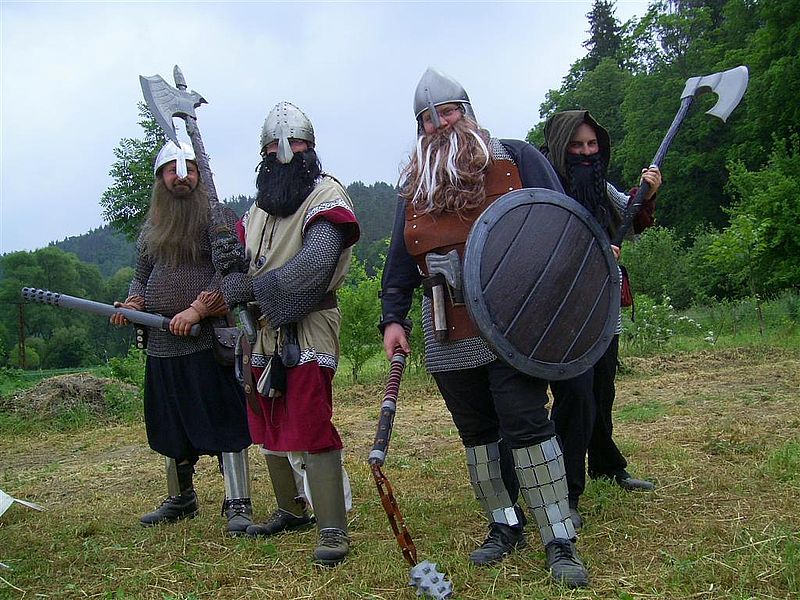
Live Action Roleplaying (LARPs) avoid the same struggles of planning & timing vs. tabletop RPGs. Photo courtesy of http://club-traumtaenzer.de/key/RollenspielCo-LARP-WasistLARP.htm

Last week’s post on meta-gaming lead to a spirited discussion on my personal G+ account and the very first reply from Alexander Williams made an excellent point. While you can read the entire conversation here (also thanks to Gerardo Tasistro for his participation), Mr. Williams’ original comment has been provided below as this week’s Random Thoughts.


When you talk about – specifically – the turn-based nature of game mechanical resolution, you’re talking very specifically about the available time that any given player has to think about their interaction with the mechanics and the environment. That has nothing to do with organization. Even the most disorganized rabble can outmaneuver and outthink an organized opponent if they have the ability to stop time whenever they like.

I know exactly why you’re making this mistake: the primary context of your role-playing (mechanically) has been D&D, in which conflicts are broken down into smaller, quantized pieces, dealt with individually, and the results of the conflict emerges post hoc from the individual contributions of those quantized bits. Notably, that’s not how all role-playing games deal with resolving conflicts in a quantum sense. (That’s not even how all wargames resolve conflicts in a quantum sense at this point.)

Compare your question based on your experience to that of someone whose primary RPG experience was developed in the context of LARPs. In most LARPs, the idea of extremely small quantized conflict resolution chunks is fairly ludicrous. That’s just not how they work. How they actually work ranges from fairly broad not-quite-scene sized chunks (old-school Vampire MET) to we-don’t-stop-for-anything-keep-up continuous-combat that involves padded swords and the potential threat of rhino-hiding. In those games, the question of how you’re heard on the other side of the bar by the person you want to talk to is something that doesn’t come up as a question. It’s a constant concern.

In the real world, we have mechanisms for taming the rabble and making them useful. Militaries have been exploring those in refining the process for thousands of years at this point. In their training, militaries focus on dividing up tasks appropriately, focusing on the success of your assigned task first, assigning leadership roles, making sure that the person in charge actually understands how to bring together a team of people to common purpose, and instills an expectation in the group of success. Observation, orientation, decision, action – this is the loop that successful organizations of people must manage successfully.

You’ve observed that groups of people with no clear leadership, unpracticed in working together, and without unlimited time don’t do very well. The one element that you absolutely must have without practiced coordination or clear leadership is infinite time. That’s the tool that highly quantized turn-based systems allow players and GM’s to use in order to have success. Imagine how little fun it would be to try and get the typical gaming group through a D&D dungeon while requiring an absolute one-to-one mapping of real-time to game time. You would either end up with an extremely cautious – rationally so – group of people barely edging their way through an extremely dangerous environment, as rational people always do, or in an organized mob blundering along until they died. Horribly. The first might be fun for the right kind of group, but the latter is pretty much guaranteed to be no fun for anybody.

There are other ways of providing resolution of conflicts in a time extended way without small-quantum resolution. Scene level resolution is a fairly common one. You make one check for success/partial success/partial failure/failure at the beginning of the scene (or at the end of the scene) and let the role-play and interplay occur within the scene in real time, informed by the knowledge that the players possess about what is likely to or definitely going to happen. That often works much better if you’re looking for modeling and creating an experience which is much closer to that of people whose competencies lie in the simulated experience rather than the active simulating it. Alternately, you can have conflicts resolved without recourse to time – that is to say that they succeed or fail predictably every time based on some specific interaction between players, whether that be holding an appropriate Role (as in Kingdom), in-scene negotiation be a ritual phrases (as in Polaris), or even assumptive success on every act (as seen in Microscope). In every case, the player knows outcomes, all the players know the outcomes, and so their play in any individual scene is much more dynamic.

Basically, you’ve described the disease that only old-school gamers got, and the only cure is more cowbell – or at least exposure to games whose resolution mechanics are significantly different than what you’re used to, and in my opinion significantly superior in most cases to what you’re used to.

This is not a slam on D&D, it should be said. Rather, it’s a slam on the entire mode that D&D plays within without considering and exposing the assumptions on which is built. Pathfinder is an equal offender. In fact, pretty much the whole lot of the OSR movement is guilty as charged. They create patterns of thought which lead to certain reinforced expectations getting in the way of actually playing in a better structure. I’m not going to pull an Edwards and say that they cause brain damage, but as you’ve already determined they can lead to habits which are less than useful if your intent with the experience you want to create is to hew more closely to the reality experienced away from the game table.

Unless the character is psionic, in which case having a conversation across the bar is pretty trivial.


Random Thoughts is an ongoing series of… well, random thoughts provided by BRG’s lead designer, The Warden. Maybe this week will talk about the effects of initiative rolls and the next will cover how cool his new dice look. Whatever comes out of his head, this column is an outlet for these ramblings.