Wheels In Motion

ScreenPlay_logo_earlyWith only 12 days before the launch of ScreenPlay‘s Rehearsal Edition, it seemed a good time to update everyone on the state of things and where the playtest stands at this very moment.

First, the promotional wheels have begun to spin as the Warden (OK, me) spoke about the game and exposed his true feelings about Michael Fassbender on the Dr. Tom the Frog show.

As for the release itself, there are a couple of areas to explore and we’ll take a look at each of them individually.

The Playtest Itself

ScreenPlay‘s editor, Vincent Harper, has completed his edits for the current draft (version 1.1) and submitted revisions based on his suggestions and in response to some additional alpha testing conducted over the weekend. (To that end, big thanks to Matthew, Jake, Darina, Matlock, and Fraser for writing a great story of Ironbound: The Curse of the Scarab Witch at Capital Gaming Expo on Saturday. Your input and outcomes definitely helped create a sharper version for everyone to enjoy on the 20th.) There are a couple of mechanical aspects under review for different reasons and I’m debating leaving them in as optional rules or leaving them inserted with everything else to see how they hold up in beta playtesting. Decisions, decisions.

There’s also the matter of expanding the third act of the Rehearsal Edition, which is the advice chapter for Directors (or Gamemasters). Reading some comments, posts, and shares about this game has given me some concerns about whether the game will meet certain expectations and I want to make sure those expectations will be met. For example, quite a few people have compared the concept of the game to Primetime Adventures, a story game in which players develop a TV series and play out the story arcs of characters across an entire season. It’s a flattering comparison and while it may be personal last minute jitters, I want to make sure anyone who expects to find similar themes from that game will be happy. The mechanics of ScreenPlay focus on the storytelling and gameplay, but it’s the actions of the Director that make it cinematic. Once I know those tools are clearly delivered, I can breathe a sigh of relief.

The ScreenPlayers Guild

Discovering how Writers, Directors, and casual readers feel about the game is the key to a successful playtest and there will be two means of accessing that input. First, each draft of the Rehearsal Edition will include three surveys, one for the three levels of participation (reading the game or playing as a Writer or Director). Second, there will be an G+ community for everyone to get together and share their comments publicly, ask questions for myself and other players, hang out, maybe start up a play-by-post game. Either way, the ScreenPlayers Guild is a way to connect with other playtesters and I encourage anyone who’s thinking about giving this a whirl to sign up now and receive 1 bonus playtest point if you join before October 20th.

What’s a playtest point? I’m glad you asked.

Playtest Points

Simply asking nicely doesn’t always do the trick, not when there are so many different games to play and so many released on a weekly basis. What we needed was to offer an incentive and that’s where playtest points come in. Anyone who provides feedback on any of the various drafts or shares a link to a draft during these 16 weeks will earn playtest points. The more points you earn, the greater your reward will be at the end. Get your name listed as a playtester in the finished product, earn PDF copies, even unlock additional adventures to playtest. And the top five people will unlock free print copies of ScreenPlay: The Director’s Cut. While I had hoped to share the current point structure with everyone, there are still come adjustments underway and it’s probably best to wait until the Rehearsal Edition launch to see for yourself.

#ScreenPlayRPG

Maximizing the number of playtesters means spreading the word and that’s where we could use YOUR help. Hence the #ScreenPlayRPG hashtag. Anyone who shares a link, posts on their blog or Facebook page, tweets, or whatever will earn 1 playtest point. That’s enough to get you credit in the finished product alone. And we’d love to see your comments, video reviews, and podcasts about it. It’s all about passing it on to the next player.

The response to date has already been rewarding and has given us cause to tighten up a few screws to ensure this first playtest draft is as ready as possible, while still leaving room for flexibility and varied feedback. The clock is counting down and the suspense is building. Soon, it will be out in the world and I will have a stash of paper bags to hyperventilate in or jumping up and down for joy on the wing of a plane 10,000 feet in the air.

Learn To ScreenPlay: Keeping Up Your Stamina

ScreenPlay: The Rehearsal Edition launches October 20, 2015.

Before we begin the third instalment of Learn To ScreenPlay, I’d like to draw your attention towards the official Learn To ScreenPlay page of this site and bring out the Learn To ScreenPlay dancers. Ok, that last one’s still waiting on auditions (and a reality check), but the rest is totally true. If this is the first one of these posts you’ve ever seen or perhaps you may have missed one in the past, we’re collecting all these teasers to our upcoming Rehearsal Edition onto one handy, dandy place.

Now on with the show.

Not every character gets to live until the end of the story. Every tale has its share of casualties, sacrificial lambs, and nameless goons who must be defeated in some gruesome fashion for the protagonists to reach the conclusion. Or sometimes it’s a protagonist who’s gotta go to add suspense to the plot. In a game like ScreenPlay, how do you determine who concludes their journey down the rabbit hole you and your fellow Writers have created? With Stamina, of course.

It’s All About Your Stamina

Stamina is very much akin to (and yet nothing like) the standard hit points you see in many roleplaying games. Each character has a maximum number of points in the beginning that are dwindled down and refreshed as the story progresses until they either reach zero and are no longer involved in the story or the story reaches the end and everyone’s happy. (Note: This can assume the character dies, but is not always the case. How a character is removed from the story remains in control of the player who dropped them down to 0 Stamina.) Whenever someone takes damage from a conflict roll, it’s Stamina that’s depleted. Survive until the end of a scene and you can recover half of your current Stamina (yet no more than your maximum amount), keeping you ready to continue on for yet another scene and bring you one step closer to the end. Pretty standard fare, but now this is where things get interesting.

Stamina also allows your character room to cheat. Certain options are available to lead and supporting characters (but not extras; they’re not supposed to stick around long enough to make it worth the effort) wherein they can cut in line and offer a description before they are chosen, increase your conflict roll by one, smack someone back even when they’ve already provided a description and more. You can get through a scene (or an entire story) without using these cheats, but if you want to use them, it’ll cost you. For each of the cheats provided below, you must spend 1 Stamina from that character’s reserve. Cheat too often and it’ll backfire on you if they dish our major damage on an even-numbered roll… and that’s the point. It’s a tempting offer and just like any deal with the Devil, you have to be prepared to pay the price for your greed.

Shift: You can spend 1 Stamina to increase or decrease the result of a die roll (either one you rolled or one rolled against you) by 1. For example, if an opponent rolls a 6 on their conflict roll, you can spend 1 Stamina to reduce it to a 5 and at least only suffer a minor complication.

Interrupt: A character who has yet to act in the current round can spend 1 Stamina to cut in line. The player can choose whether they want to interrupt before another player is chosen or before or after a character’s description is provided.

Retaliate: Immediately following a conflict roll, regardless of its outcome, a player can spend 1 Stamina for the targeted character to make a conflict roll of their own against the same opponent.

Remove a Minor Complication: You can spend 1 Stamina to remove a minor complication with one detail instead of a full description.

And to answer the immediate question, lead characters start with a story with 15 Stamina, supporting characters start with at least 7 Stamina (if they’re designed for a Writer; Directors have flexibility to take it as high as 50 Stamina for those truly bad-ass villains), while extras never have more than 3 Stamina (and can never use the cheats mentioned above).

Taking It To Another Level

But is that as much Stamina as you’ll ever have to work with? Not by a long shot, it simply depends on how faithful you are to the development of the story, your characters, and the spirit of gameplay. It is entirely possible for characters to increase their maximum Stamina through the collection of what’s called milestones… and that’s where we introduce a cliffhanger. Next time, we’ll discuss these points and how they help keep everyone on the same page.

Catch A Sneak Peak of ScreenPlay at the Capital Gaming Expo

CGX-weblogo1Think of this as an advanced screening of a little game we call ScreenPlay: The Rehearsal Edition taking place October 3rd from 2:30 pm to 6:30 pm at the newly renovated Capital Gaming Expo. Not only will this be an opportunity for anyone in the Ottawa area to try out this storytelling RPG of true democratic storytelling (the only kind of storytelling, am I right?), but it will also be the premiere of the first treatment (AKA adventure) for ScreenPlay entitled “Ironbound: The Curse of the Scarab Witch.” Details from the CGE site below.

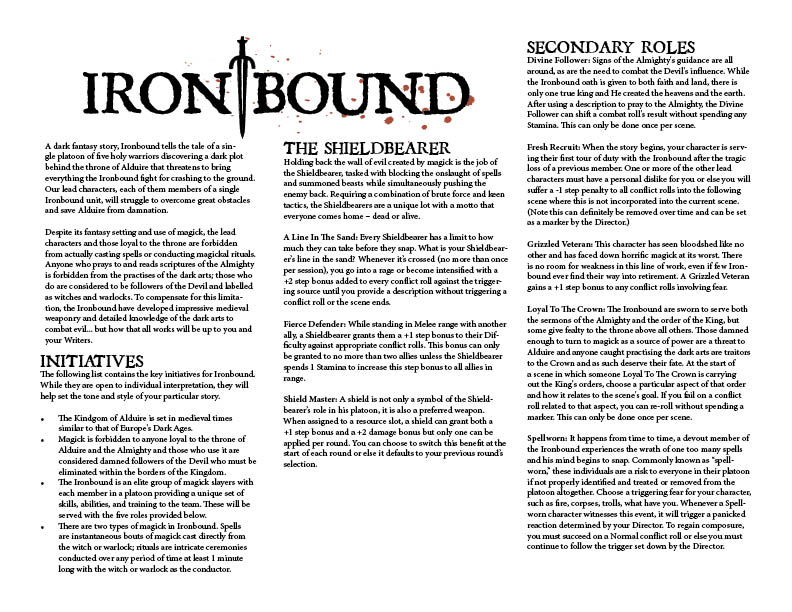
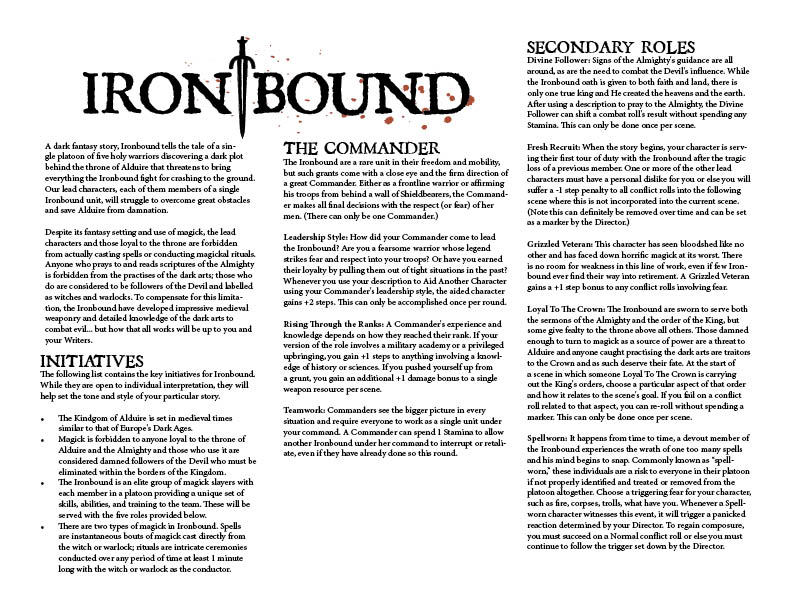
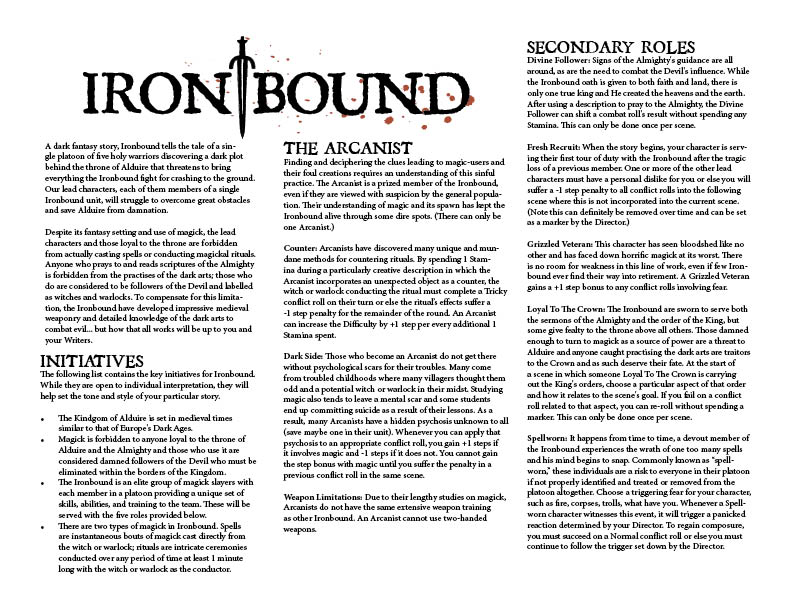
For over a century, the Ironbound has sworn allegiance to punish all those who would practice the dark craft of magick, be they summoner, conjurer, or anything in between. Every member of this esteemed order have taken the vow to study all there is to know of their opponents while never applying theory to practice, utilizing the forbidden knowledge of spells and rituals to bring about their defeat and pass judgement for the security of the Kingdom. Will you answer the call of the Ironbound?

This will be the premiere playtest launch for a new story RPG system scheduled for release in 2016 by Broken Ruler Games and we’re looking for imaginative players to take on the role of Writers working with the Director to help craft the story of a single squadron dispatched to rescue a lost child abducted by the Scarab Witch. What makes this game unique is that you will not simply react to the predetermined events, you will actively shape the world and tell the story together using the ScreenPlay system. In addition to having a great time, you’ll also receive alpha-level playtester credit and a PDF copy of the finished product upon this game’s release slated for sometime in 2016.

As a special incentive, here are JPEG previews of the character notes and roles you’ll be using when you sign up to play. And if you’re unable to join due to geography, you can still look at them and get ready to try it out for yourself when the Rehearsal Edition drops October 20th.

ScreenPlay_charactersheet

ScreenPlay_Ironbound_shieldbearer ScreenPlay_Ironbound_scout ScreenPlay_Ironbound_commander ScreenPlay_Ironbound_blade ScreenPlay_Ironbound_arcanist

Learn To ScreenPlay: Damage and Challenges

ScreenPlay: The Rehearsal Edition launches October 20, 2015.

Tension and stress are two key elements to dramatic storytelling, regardless of whether you accomplish this through high stakes negotiations, car chases, shootouts, even a first date. Bringing those elements into a game of ScreenPlay is what this week’s lesson is all about because as awesome as it is to do whatever you want simply by describing it does not necessarily equal a fun game. Tension and stress create challenges for all players to overcome despite your personal desires and when you overcome those challenges, the game becomes all the better.

In this week’s instalment of Learn To ScreenPlay, we’re going to cover two of the biggest threats to Writers and their characters: damage and challenges.

Dishing Out The Damage

If there’s a staple in nearly every action-based RPG out there, it’s damage. We covered complications and how they work their magic in last week’s premiere instalment of Learning To ScreenPlay, but there are times when you simply want to have your character beat the crap out of another character. Do you need to all the time? No. Are there moments when it’s more advantageous to hinder an opponent by knocking them to the ground, locking them inside a burning car, or drug them so they stumble around the nightclub in a daze? Most definitely. But there are also times when smacking your villain senseless and eliminating them from the scene entirely is the way to go and that’s where damage comes in.

Before we can explain damage, let’s introduce you to resources. Your characters can carry any number of items, articles of clothing, and however many tiny pocket-filling objects seems reasonable without any burdening rules for encumbrance, pre-assigned equipment lists, and the standard mechanics of items in many games. Resources are specifically assigned items players select as key items and skills they wish to apply in the upcoming scene. They can provide either a step bonus (increasing your conflict roll dice by one size, such as a d8 to a d10) or a damage bonus and these are noted on the character sheet at the start of the scene to suit whatever your character wants to accomplish and how they want to do it.

Damage reduces a character’s Stamina and when it reaches 0, the character is removed from the scene. How they’re removed depends on who dropped them to 0 and the odds of your friends doing this are slim, so you can imagine the typical end result. Any character can choose to inflict damage instead of placing a complication whenever prompted by a conflict roll. Just like complications, damage comes in two forms: major and minor damage. Whenever you can place a major complication on a character, you can instead inflict major damage and the same goes with minor damage substituting minor complications. Minor damage is only the damage bonus assigned to a particular resource involved in a description. Major damage is a juicier version where you combine the damage bonus of your resource with the difference between your conflict roll result and the Difficulty. So if you roll an absolute 12 on a d12 against your average extra’s Difficulty of 3 and it’s with a two-handed baseball bat granting a +2 damage bonus, that’s 11 damage. And when you consider the average lead character starts off a story with 15 Stamina… ouch.

Looking For A Challenge?

There is an inherent risk in a game like ScreenPlay where the players are calling the shots and helping to create the danger they’ll face: how do you know they won’t simply play the easiest possible version of the game? There are two solutions to this risk. One, ask yourself if you’re playing with friends like this and why. Two, use challenges.

Challenges are points accumulated by the Director during the course of the story. Without getting into specifics, they basically land in the Director’s palm whenever the Writers have it easy or accomplish something really impressive. Ok, one example. Whenever anyone rolls the highest possible value on their conflict roll, it’s known as an absolute and means that result cannot be altered in any way by another player. When a Writer rolls an absolute, the Director gains 1 challenge. From that point on until the end of the story, the Director can redeem these challenges to ramp up the tension and make things harder for the Writers and their characters.

Let’s say the lead characters are detectives solving a triple homicide that soon becomes revealed as the work of a satanic cult who is actually lead by an angel. After kicking down the door to a presumed abandoned warehouse, the detectives find themselves setup and need to escape in a serious hurry. In no time flat, the Writers describe their detectives stay miles ahead of their attackers and easily make it to the fire escape to freedom… until the Director decides that’s not nail-biting enough and redeems 1 challenge to alter the setting a little bit – the doors have been chained shut from the outside. Now, with the cultists literally steps away from their prey, the detectives have to resort to Plan B.

A Game Of Survival Against The Odds

That’s the kind of tension we’re talking about, no matter the genre, mood, or style you’re going for in your story. When one really good (or really bad) dice roll can lead to half of your Stamina suddenly spilled all over the floor or discovering the Director has other plans for your big action sequence, things can take a sudden and amazingly entertaining turn.

So what else can you do with Stamina to make them so damned important? Join us next week when we shed a little light on what keeps your characters ticking.